
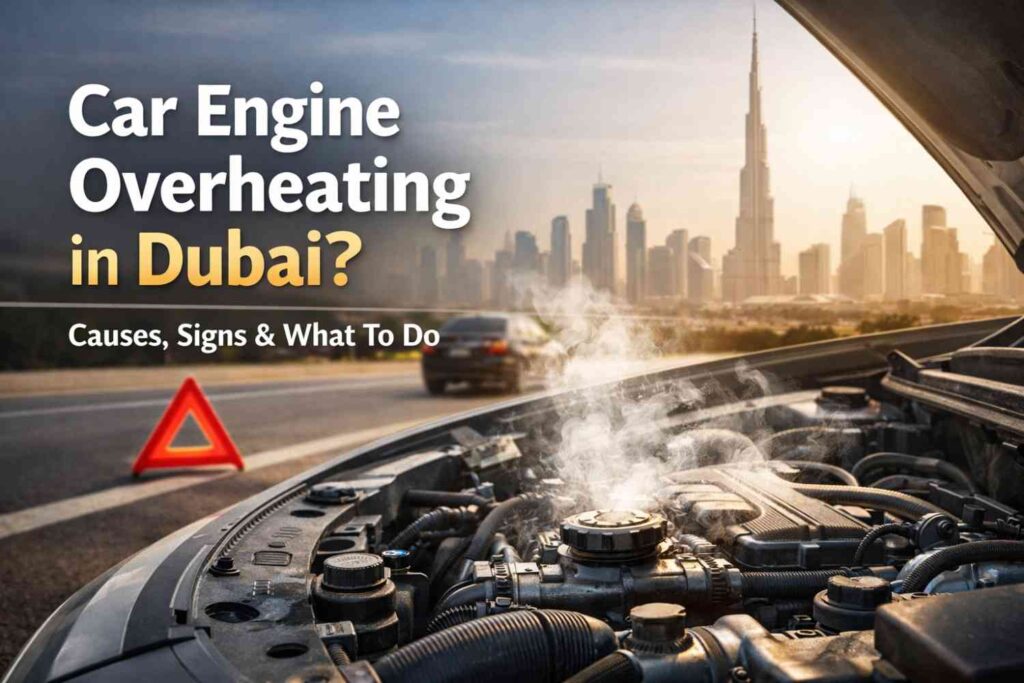
Is your temperature gauge in the red RIGHT NOW? Stop reading, pull over immediately, switch off the engine, and call DoctoCars: +971 50 100 8540
Your car’s temperature gauge creeps toward the red. Steam hisses from under the bonnet. A warning light flashes on your dashboard. In most cities, this is a serious inconvenience. In Dubai, where ambient temperatures regularly exceed 45°C and traffic on Sheikh Zayed Road can bring you to a standstill for 40 minutes, a car engine overheating is a genuine emergency.
Drive even a short distance with an overheating engine in Dubai’s summer heat, and you risk catastrophic, irreversible engine damage, the kind that can cost AED 15,000–40,000 to fix, or write off your vehicle entirely. The difference between an AED 500 repair and an AED 15,000 engine rebuild is often just five minutes of decision-making.
This guide explains exactly what causes engine overheating in Dubai’s unique conditions, the warning signs to watch for before it becomes critical, and the precise steps to take if it happens to you, so you can protect your engine and your wallet.
Engine overheating or warning light on? Book engine repair at DoctoCars → Same-day diagnostics in Al Quoz, Dubai.
Why Dubai Is the Worst City in the World for Engine Overheating
Engine overheating is not a Dubai-specific problem,but Dubai makes every contributing factor exponentially worse. Here’s why:
- Extreme ambient temperature: Engines are engineered to operate in environments between -10°C and 35°C. Dubai regularly hits 45°C ambient and 65°C road surface temperatures in July and August. Your cooling system is working at its absolute limit before you’ve even left the driveway.
- Stop-start traffic: On highways like Sheikh Zayed Road, Al Khail Road, and around Business Bay, traffic can idle for 30–45 minutes. When a car is stationary, the engine generates full heat but receives no cooling airflow, placing maximum pressure on the radiator and coolant system.
- Air conditioning load: Running AC in Dubai is not optional; it’s a survival necessity. But AC adds significant load to the engine, generating additional heat precisely when the cooling system is already stressed by ambient temperature.
- Dust and sand blockage: Dubai’s dusty environment, particularly during Shamal wind periods, clogs radiator fins and air filters far faster than in most cities, reducing cooling efficiency over time without any obvious single failure event.
- Older coolant degrading faster: Coolant that lasts 3–4 years in a European climate may degrade in 18–24 months in UAE conditions. Degraded coolant loses its anti-corrosion properties, accelerating internal rust that then blocks coolant passages.
5 Engine Overheating Warning Signs — Before It Becomes Critical
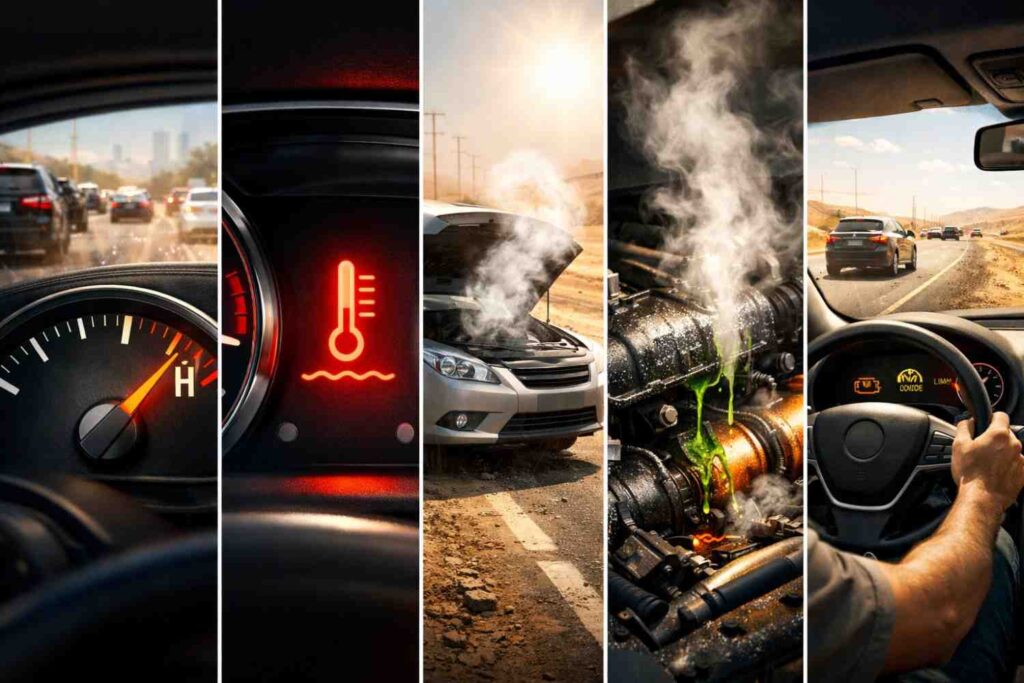
Engines rarely overheat without warning. Knowing these five signals — in order of severity — could save your engine and AED 10,000+.
⚠️ Warning Sign 1: Temperature Gauge Climbing Above the Midpoint
Your dashboard temperature gauge has a normal operating range — typically sitting just below the midpoint. If you notice it creeping above this range during heavy traffic or uphill driving, your cooling system is under stress. This is Stage 1 — the engine is not yet overheating, but it is trending in the wrong direction.
What to do: Turn off the AC immediately. This removes approximately 10–15% of engine load. Turn on the cabin heater to maximum — counterintuitive, but it acts as a secondary heat exchanger and pulls heat away from the engine. If the gauge continues rising, pull over safely.
⚠️ Warning Sign 2: Temperature Warning Light Illuminates
A red or orange thermometer icon on your dashboard means the engine coolant has reached a critical temperature — typically above 110–120°C. At this point, you are in Stage 2. The engine is overheating right now.
🚨 Do NOT continue driving with the temperature warning light on in Dubai summer. Pull over within 1 km. Further driving risks include head gasket failure.
⚠️ Warning Sign 3: Steam or Smoke from Under the Bonnet
Steam rising from under your bonnet is coolant boiling and escaping under pressure. This indicates a coolant leak — either from a hose, the radiator, or the coolant reservoir cap — combined with an overheating engine. If you see steam, pull over immediately. Do not attempt to open the bonnet for a minimum of 30 minutes.
⚠️ Warning Sign 4: Burning or Sweet Smell Inside the Cabin
A sweet, slightly sickly smell — like hot sugar — is the distinctive odour of engine coolant (ethylene glycol) burning on hot engine components. This smell means coolant is leaking and hitting the exhaust or engine block. A burning plastic or rubber smell indicates that coolant hoses or wiring are also affected. Both require an immediate stop.
⚠️ Warning Sign 5: Loss of Engine Power with Rough Running
When an engine reaches extreme temperatures, it enters ‘limp mode’ — reducing power to protect itself. If you notice your car feels sluggish, hesitates on acceleration, or the engine sounds rough alongside a high temperature reading, you are at Stage 3. Engine damage may already be occurring. Pull over, switch off the engine, and do not restart it. Call DoctorCars recovery immediately.
6 Most Common Causes of Car Engine Overheating in Dubai
Each of these causes is more prevalent in Dubai’s climate than anywhere else. Understanding which cause applies to your situation helps your mechanic diagnose faster, and you understand your repair quote.
1. Coolant Leak — The #1 Cause in Dubai
Coolant can leak from multiple points: the radiator itself, rubber hoses that degrade faster in UAE heat, the water pump seal, the thermostat housing, or — most expensively — the head gasket. Even a small leak reduces cooling capacity dramatically. Dubai’s heat accelerates rubber degradation, making coolant hose leaks far more common than in cooler climates.
Signs of a coolant leak: puddle under the car (sweet-smelling, often green or orange liquid), low coolant level warning, frequent need to top up coolant.
2. Faulty Thermostat
The thermostat is a small valve that regulates coolant flow between the engine and radiator based on temperature. If it sticks closed, coolant cannot reach the radiator to be cooled — the engine temperature rises rapidly regardless of how much coolant is in the system. Thermostat failure is inexpensive to fix (AED 200–500) but causes expensive damage if ignored.
3. Failed Water Pump
The water pump circulates coolant through the engine. When its impeller cracks, its bearing seizes, or its belt/chain breaks, coolant circulation stops entirely. Water pump failure often announces itself with a whining or grinding noise from the front of the engine before total failure. In Dubai, water pumps tend to fail earlier than manufacturer guidelines predict due to the additional thermal stress.
4. Blocked or Damaged Radiator
The radiator dissipates heat from the coolant into the outside air. Dubai’s sand and dust environment blocks radiator fins progressively over time, reducing efficiency. A significant blockage can reduce cooling capacity by 30–40%. Physical damage from road debris, even small stones, can cause radiator leaks. Annual radiator cleaning is strongly recommended for vehicles in Al Quoz and industrial Dubai areas.
5. Low or Degraded Engine Oil
Engine oil does not just lubricate , it also removes approximately 40% of the heat generated by combustion. Running low on oilor running on degraded oil that has lost its viscosity dramatically increases engine temperatures. In Dubai’s extreme heat, engine oil breaks down faster than manufacturer service intervals assume. Full synthetic oil and a 5,000 km oil change interval are the minimum recommendations for UAE conditions.
6. Head Gasket Failure
The head gasket seals the joint between the engine block and cylinder head. When it fails — often as a consequence of a previous overheating episode — combustion gases enter the cooling system, preventing it from functioning properly. Head gasket failure is the most expensive overheating-related repair (AED 3,000–8,000) and the most common result of ignoring earlier warning signs.
DoctoCars insight: Over 60% of the major engine repairs we handle in Al Quoz are the direct result of an earlier overheating warning sign that was ignored. Catching any of the above issues early typically costs AED 200–800. Waiting until breakdown costs AED 3,000–15,000.
Overheating engine? Get expert diagnosis at DoctoCars.
Certified mechanics · Advanced diagnostics · Genuine parts · 6-month warranty on all repairs
View Engine & Mechanical Repair Services → — Al Quoz, Dubai | +971 50 100 8540
What To Do When Your Car Overheats in Dubai: Step-by-Step
Follow these steps in exact order. Deviation — particularly opening the bonnet immediately or adding cold water to a hot engine — can cause serious injury and additional engine damage.
- Switch on your hazard lights immediately. Signal to surrounding vehicles that you have a problem and are slowing down.
- Move to the nearest safe stopping point. Hard shoulder, service road, or petrol station. Do not stop on the main carriageway of Sheikh Zayed Road, E311, or any fast highway. Dubai roads have high-speed traffic, and stopping on the main lane is extremely dangerous.
- Switch off the engine. Do not leave the engine running. Turn off the ignition completely.
- Stay in the vehicle withthe air on recirculate, if the AC still works. If the temperature is extreme and you cannot stay in the car, move to shade but stay near the vehicle.
- Wait a minimum of 30 minutes before opening the bonnet. The cooling system is under pressure, and the coolant may be boiling. Opening the radiator cap on a hot engine can cause boiling coolant to erupt and cause serious burns. 30 minutes is the minimum safe wait time.
- Do NOT add cold water to a hot engine. Thermal shock from cold water hitting a hot engine block can crack the block or cylinder head — a repair that costs AED 8,000–25,000. Only add coolant (or distilled water as a temporary measure) once the engine is fully cool.
- Call DoctoCars for emergency recovery. Our 24/7 recovery team covers all Dubai locations — Sheikh Zayed Road, E311, Downtown, Dubai Marina, Business Bay, JVC, Al Barsha, and all surrounding areas.
🚗 Broken Down in Dubai? DoctoCars 24/7 Emergency Recovery
We come to you — fast response across all Dubai areas. Call +971 50 100 8540 or book emergency recovery here →
Engine Overheating Repair Cost in Dubai — What to Expect
Repair cost varies enormously depending on which component failed and how long the overheating was allowed to continue. This table gives you an accurate expectation before your workshop visit.
| Repair Type | Est. Cost (AED) | Time to Complete | Urgency Level |
| Coolant top-up + leak check | AED 80–200 | 30–60 min | 🟡 Moderate |
| Coolant hose replacement | AED 200–600 | 1–2 hours | 🟡 Moderate |
| Thermostat replacement | AED 250–550 | 1–3 hours | 🟠 High |
| Radiator repair/flush | AED 300–800 | 2–4 hours | 🟠 High |
| Radiator full replacement | AED 700–2,000 | 3–5 hours | 🟠 High |
| Water pump replacement | AED 600–1,800 | 3–6 hours | 🔴 Critical |
| Head gasket repair | AED 2,500–6,000 | 2–4 days | 🔴 Critical |
| Engine block repair / rebuild | AED 8,000–25,000 | 1–3 weeks | 🔴 Emergency |
✅ DoctoCars provides a full written quote before any work begins. You approve — we work. No surprise bills. All repairs carry a 6-month warranty.
How to Prevent Engine Overheating in Dubai — 6 Maintenance Steps
Prevention costs a fraction of repair. These six steps, followed consistently, will significantly reduce your risk of engine overheating in UAE conditions.
- Check coolant level monthly, not just during service. In summer, check every 2–3 weeks. Top up only with the manufacturer-specified coolant type — mixing types damages the system.
- Change coolant every 2 years (not 3–4 years as manufacturers state), because UAE heat degrades it far faster than temperate climates assume.
- Use full synthetic engine oil and change it every 5,000 km, not the 10,000 km some manufacturers suggest. Dubai’s heat breaks down conventional and semi-synthetic oil significantly faster.
- Have your radiator cleaned annually, particularly if you drive in dusty areas, construction zones, or near the desert. A 30-minute clean at DoctoCars is AED 80–120.
- Book a pre-summer service in March or April — before temperatures peak. Our summer check includes coolant level and condition, hoses, thermostat function, oil quality, and radiator inspection.
- Watch your temperature gauge as a habit. Most Dubai drivers ignore it until the warning light appears. A gauge that sits slightly higher than usual during traffic is a symptom — address it before it becomes a crisis.
Why Dubai Car Owners Trust DoctoCars for Engine Overheating Repairs
When your engine is at risk, you need a workshop that diagnoses accurately the first time and repairs correctly. DoctoCars in Al Quoz has built its reputation in Dubai specifically on this.
- Advanced computer diagnostics: We use professional-grade diagnostic tools — not basic OBD scanners — to read every fault code across your engine, cooling, and electrical systems before we touch the car. You get a precise diagnosis, not guesswork.
- Certified mechanics who know UAE conditions: Our technicians are trained on European, American, and Japanese vehicles and specifically experienced in Dubai’s thermal stress patterns. We see overheating repairs every single week.
- Genuine and OEM parts: We use manufacturer-approved parts. Aftermarket cooling components — particularly thermostats and water pumps — have a poor failure rate in UAE conditions.
- Transparent pricing, always: Samir, our workshop manager, personally explains every diagnosis finding and quotes before work begins. You approve the repair. You understand the cost. No hidden charges.
- Extended 6-month repair warranty: All engine and cooling system repairs carry a 6-month parts and labour warranty. If the same fault returns within 6 months, we fix it at no cost.
- 24/7 emergency recovery across Dubai: If your engine overheats on the road, we come to you. Al Quoz, Downtown, Dubai Marina, Business Bay, Jumeirah, Al Barsha, and Dubai Hills — all covered.
See All Car Repair Services at DoctoCars
Engine repair · AC service · Gearbox · Electrical · Recovery · Full maintenance
👉 View All Services at DoctoCars → — Al Quoz, Dubai | +971 50 100 8540
Frequently Asked Questions — Car Engine Overheating in Dubai
Q: Is it safe to drive with the engine temperature warning light on in Dubai?
No. You should pull over within 1 km and switch off the engine. Continuing to drive in Dubai’s ambient heat with an overheating engine — even for 5–10 minutes — can cause head gasket failure or crack the engine block. Both repairs cost AED 3,000–25,000.
Q: What causes cars to overheat more in Dubai than in other countries?
Dubai combines several uniquely damaging factors: 45°C+ ambient temperature (far above engine cooling system design limits), prolonged stop-start traffic that eliminates airflow cooling, full-time AC load that adds heat to the engine, dusty conditions that clog radiators, and UV-accelerated degradation of cooling system rubber components. Each factor alone is manageable. All five together stress cooling systems to their limit.
Q: Can I add water to my overheating engine on the roadside in Dubai?
Only once the engine is completely cold, a minimum of 30 minutes after switching off. Never add cold water to a hot engine. Thermal shock can crack the engine block or cylinder head, adding AED 5,000–15,000 to your repair bill. If you must add liquid, use distilled water or proper coolant at room temperature only after the engine is cold.
Q: How much does engine overheating repair cost in Dubai?
It depends entirely on what failed and how long the overheating was allowed to continue. A coolant top-up and hose repair can cost AED 200–600. A thermostat or water pump replacement runs AED 400–1,800. Head gasket failure — the most common result of ignored overheating — costs AED 2,500–6,000. A full engine rebuild after catastrophic failure can reach AED 15,000–25,000. DoctoCars provides a full written quote before any work begins.
Q: Does DoctoCars offer emergency car recovery for overheating breakdowns in Dubai?
Yes. DoctoCars operates 24/7 emergency car recovery across all Dubai areas. If your engine overheats on Sheikh Zayed Road, E311, Al Khail Road, or anywhere else in Dubai, call +971 50 100 8540. We tow your vehicle to our Al Quoz workshop for a same-day diagnosis. Do not attempt to restart an overheated engine and drive to a garage — this dramatically increases repair costs.
Q: How can I prevent my engine from overheating in the Dubai summer?
Monthly coolant level checks, annual coolant flush, full synthetic oil changes every 5,000 km, annual radiator cleaning, and a pre-summer vehicle inspection in March/April are the five most effective prevention steps. DoctoCars offers a comprehensive pre-summer vehicle check from AED 200 that covers all cooling system components.
Q: How long does engine overheating repair take at DoctoCars?
Minor repairs — coolant top-up, hose replacement, thermostat — are typically completed the same day within 1–4 hours. Water pump replacement takes 4–8 hours. Head gasket repair requires 2–4 days. DoctoCars provides a time estimate with every repair quote so you can plan accordingly.
PROTECT YOUR ENGINE — BOOK WITH DOCTOCARS TODAY
Al Quoz, Dubai · +971 50 100 8540 · info@doctocars.com · 24/7 Emergency Recovery
Engine & Mechanical Repair → 24/7 Car Recovery → All Services →