
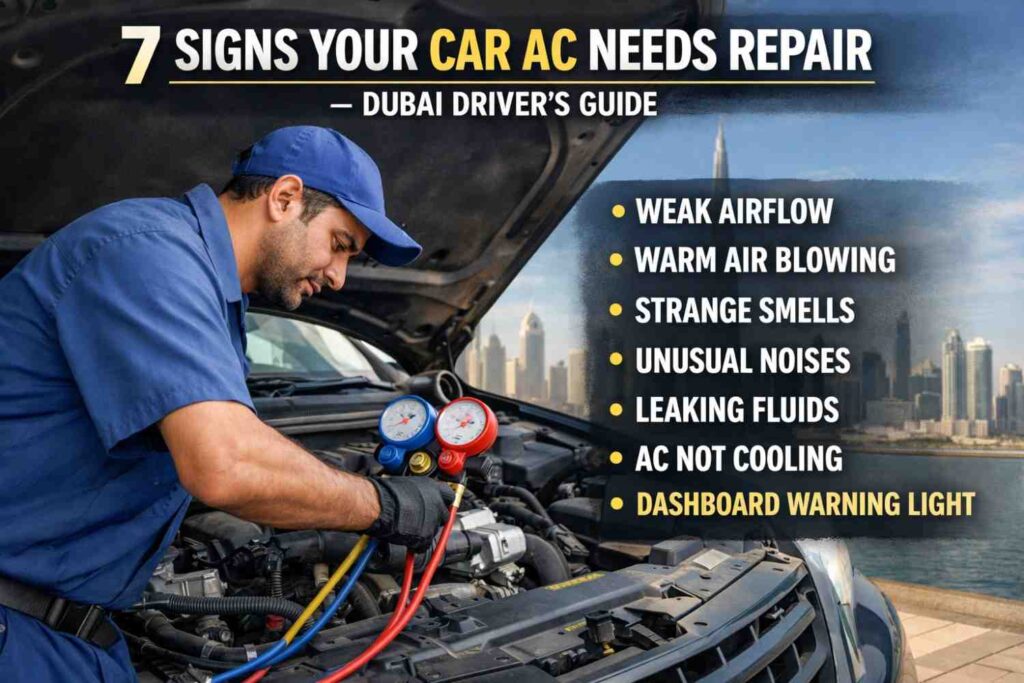
Dubai’s relentless heat turns every drive into a test of endurance without a working car AC. Spotting trouble early keeps you cool during peak summer gridlock. This guide covers the seven most common red flags UAE drivers encounter, tailored to local conditions like dust storms and 50°C days.
7 signs car AC needs repair in Dubai
The UAE’s extreme climate accelerates AC wear far beyond normal. Constant high temperatures, fine sand infiltration, and stop-start traffic in areas like Deira or Downtown push systems to their limits. Drivers often ignore early warnings until full breakdowns hit during rush hour. Below, we detail each sign, its causes in Dubai’s environment, diagnostic steps, and fixes to get you back to icy vents fast. Addressing these promptly avoids compressor failures that can cost thousands in repairs.
Sign 1: Warm Air from the Vents
The most frustrating issue hits when cold air turns lukewarm mid-commute. This usually stems from low refrigerant levels due to gradual leaks in hoses, seals, or the condenser. In Dubai, the intense sun bakes rubber components, causing them to crack sooner, while road debris punctures delicate fins.
You’ll notice it first on shorter trips or after parking in direct sunlight, where cabin temperatures soar past 60°C before startup. The compressor struggles to maintain pressure, blowing ambient heat instead.
Quick diagnostic: With the engine at 1500-2000 RPM, AC on max cold and recirculation mode, vent temperature should read 5-10°C. Anything warmer signals low gas—typically R134a or newer R1234yf in modern cars. Avoid DIY recharges; they mask underlying leaks. Local mechanics add UV dye under pressure, then use blacklights to trace escapes. Expect AED 250-700 for a full service, including evacuation and refill. Delaying risks seizing the compressor entirely, a AED 2,500+ replacement.
Dubai workshops in Al Quoz or Jebel Ali handle hundreds of these weekly. Book early mornings to beat the queue, and consider annual pre-summer checks to preempt it.
Sign 2: Weak Airflow from Vents
Instead of a strong blast, air barely whispers out, leaving the cabin muggy. Dubai’s pervasive dust clogs cabin air filters in as little as a month, restricting flow to the blower motor. Deeper blockages in the evaporator or ducts compound it, often from sand buildup during haboobs.

This forces the system to work harder, icing the coils and halting cooling altogether. High humidity after rare rains adds moisture, promoting mould that further impedes airflow.
Test it: Place a lightweight tissue against the vent—it should hold steady against suction. If it flutters weakly, swap the filter first (AED 50-120, often DIY under the glovebox). Persistent issues point to a failing blower or sealed expansion valve. Clean the condenser grille of insects and grit too, as Dubai roads fling plenty.
Regular monthly filter rinses extend life, especially for SUVs with larger intakes. Weak flow also spikes fuel use by overworking the engine—fix it before efficiency drops further.
Sign 3: Strange Noises When AC Runs
Unusual sounds like grinding, hissing, or rattling emerge under the dash or hood. These indicate debris trapped in the blower fan, worn compressor bearings, or a slipping clutch—exacerbated by UAE heat expanding metal unevenly.
Hissing often means refrigerant hissing out through a puncture, while squeals signal belt slippage from oil contamination. In heavy traffic on Sheikh Zayed Road, vibrations amplify everything.
Listen diagnostic: Normal operation is a soft compressor “click” on engagement followed by near-silence. Grinding suggests internal wear; dash rattles mean leaves or plastic bits (common after open windows in sand). Pop the hood and use a mechanic’s stethoscope for precision.
Tighten or replace belts for AED 150-300; full blower cleanings run AED 400. Compressor overhauls? AED 1,800-3,000. Dubai’s RTA-approved garages use noise spectrum analysers for quick IDs—don’t drive with rattles, as fragments can shred the system.
Sign 4: Bad Smells Blowing from Vents
A musty, sour, or vinegar stench fills the car seconds after startup, pointing to mould colonies in the damp evaporator core. UAE’s post-AC moisture plus occasional humidity spikes create perfect breeding grounds, with blocked drain tubes flooding the issue.
Bacteria and mildew circulate, irritating eyes and lungs amid Dubai’s polluted air. Sweet chemical odours signal refrigerant leaks—toxic and urgent.
Sniff test: Fresh air mode on high fan for 30 seconds reveals the source. Spray antimicrobial foam into intake vents (AED 80 kits), or opt for pro ozone blasts (AED 350-500) that kill 99% of microbes. Run fan-only on dry days to evaporate trapped water.
Prevent with bi-annual deep cleans and fresh air blasts weekly. In humid Sharjah drives, this saves health visits too.
Sign 5: Slow Cabin Cooling
The AC runs but takes ages—10-15 minutes—to drop interior temps, or cycles inconsistently. Dirty condenser coils, faulty sensors, or partially blocked valves cause this lag, overwhelmed by Dubai’s radiant heat soaking through the glass.
Parked cars hit oven-like internals, demanding peak BTU output that strained parts can’t deliver.
Benchmark check: From hot soak, vents should hit 7-12°C within 5 minutes at idle. Use an infrared thermometer on high/low-pressure lines for imbalances. OBD scanners (AED 50 rentals at auto stores) reveal thermostat or sensor codes.
Flush coils and recharge for AED 400; valve swaps add AED 600. Pre-cool with remote start apps if equipped—vital for Dubai mall parking.
Sign 6: Fluid Leaks or Wet Interiors
Puddles of water or oily fluid appear under the car, or carpets stay damp. Clogged evaporator drains from debris cause interior flooding; condenser punctures from curbside scrapes leak refrigerant outside.
UAE’s abrasive roads corrode aluminium faster, with salt from coastal drives accelerating it.
Spot it: Clear drips are normal condensation (AC sweat), but oily residue or steady streams aren’t. Add UV dye, run the system, and inspect with a blacklight. Pressure tests confirm.
Seal minor holes with epoxy (AED 500), replace damaged coils (AED 1,000+). Dry carpets immediately to kill mould—fans or dehumidifiers work overnight.
Sign 7: Electrical or Power Draw Problems
AC engagement dims headlights, slows acceleration, or triggers warning lights. A dragging clutch, faulty relay, or weak alternator overloads the system, worsened by Dubai’s heat, sapping battery life.
Voltage test: Multimeter across battery terminals—a drop of over 0.5V under load means trouble. Clean corroded grounds and test compressor draw (should be 3-5 amps).
Relays cost AED 100; alternator rebuilds cost AED 1,200. Rare but critical for hybrids/EVs with integrated systems.
Dubai-Specific AC Stressors
Endless 40°C+ days evaporate refrigerant 2x faster; sand invades every crevice. RTA requires functional AC for licensing—non-compliance fails inspections. High-mileage expat cars suffer most.
Maintenance for UAE Roads
Service annually (AED 200-400): gas top-up, leak tests, filter swaps. DIY: Shade park, weekly AC runs, condenser rinses. Trusted Dubai spots include AutoPro, Fixit, or YallaFix chains for mobile service.
FAQs
What is the $5000 rule for AC?
If repair costs hit $5000 or 50% of a new system’s price, replace it—smart math for Dubai’s high-use vehicles.
What is the 3-minute rule for AC?
Wait 3 minutes after shutdown before restarting; lets pressures balance, protecting the compressor from liquid damage.
How do I check whether my car’s AC is working properly?
Engine at 1500 RPM, max cold, recirculate: Vents 15-20°C below outside air, strong even flow, quiet cycle.
What is the most common AC problem in cars?
Refrigerant leaks leading to warm output—Dubai heat and dust speed them up.
What are 6 obvious signs of air conditioning problems?
Warm air, weak flow, noises, odours, leaks, slow cooling—core indicators everywhere.
How to find a blockage in the car’s AC system?
Hook up manifold gauges for low/high pressure reads; imbalances flag evaporator/condenser clogs. Flush with dye or solvent confirms.